Organizations invest heavily in culture to drive transformation, yet many struggle to translate cultural intent into consistent behaviors at scale. The reason: culture sets direction, but structure determines execution. The third article from HR Transformation Series explores how organizational structure (governance, roles, processes, and incentives) shapes behavior more powerfully than values alone.
Written by Fabio Panella.
Table of Contents
- 1. From Invisible to Visible
- 2. The Limits of Culture Alone
- 3. What Do We Mean by “Structure”?
- 4. The Alignment Problem: Culture vs Structure
- 5. From Statics Org Charts to Dynamic Operating Models
- 6. Practical Perspective: What Works (and What Doesn’t)
- 7. Toward Living Systems: Rethinking How Organizations Grow
- 8. The Role of HR: From Support Function to System Architect
- 9. Introducing Technology
- 10. Conclusion
- References
- About the Author
1. From Invisible to Visible
Organizations do not fail to transform because they lack ambition. They fail because they misunderstand what actually drives change.
In recent years, culture has been positioned as the foundation of transformation. Leaders have invested heavily in defining values, shaping narratives, and aligning around purpose. The assumption is clear: if you get the culture right, everything else will follow.
And to some extent, this is true.
Culture is the soil. It defines the environment in which behaviors can emerge, take root, and grow. But soil alone does not create a tree.
Despite significant efforts, many organizations struggle to translate cultural intent into consistent behaviors at scale. The reason is increasingly well understood: culture does not change through messaging alone, it changes when the underlying systems change.
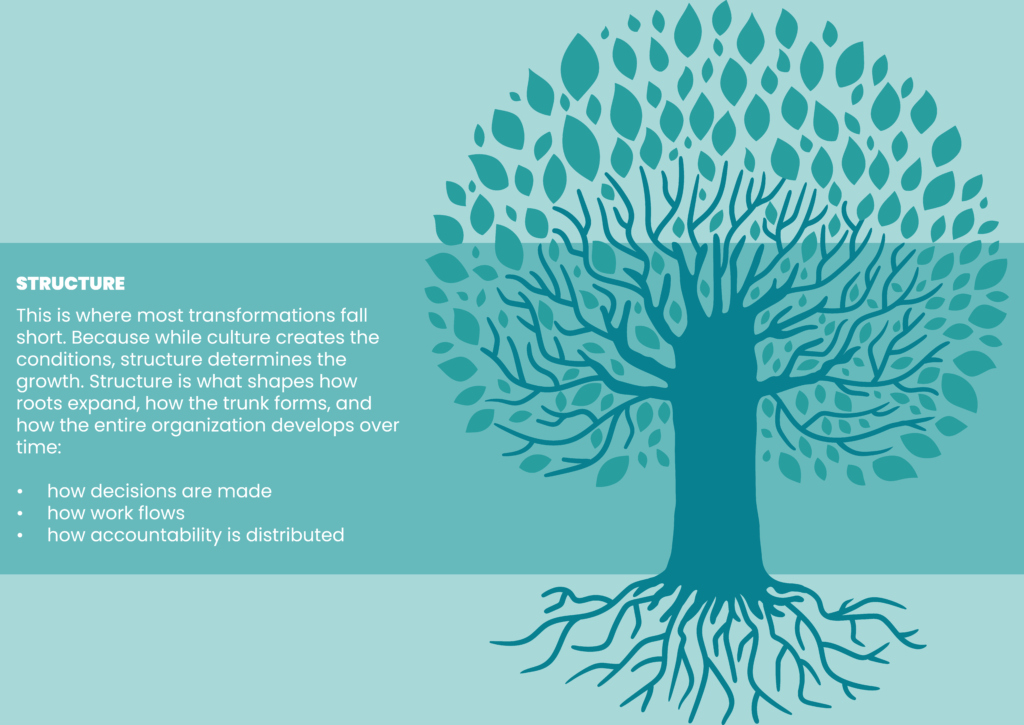
In other words, culture is the soil and structure is how the tree actually grows.
If the structure is misaligned, even the richest soil will not produce the intended outcome, because ultimately, organizations are not only aligned by what they believe, they are aligned by design, whether intentional or not.

2. The Limits of Culture Alone
If culture is the soil, then most transformation efforts today are focused on improving it. Organizations redefine their values, invest in leadership alignment, and amplify communication. The intention is clear: create the right environment, and the right behaviors will follow.
To a certain extent, they do. But not consistently. Not at scale. Even in the richest soil, roots do not grow freely. They expand, adapt, and stabilize based on the structure that surrounds them.
In organizations, that structure is not culture, it is the system within which people operate, and this is where a fundamental misunderstanding persists:
Leaders often assume that behaviors are driven primarily by values, but in reality, behaviors are also shaped by constraints, by the way decisions are made, by how accountability is defined, and by how work is organized on a daily basis.
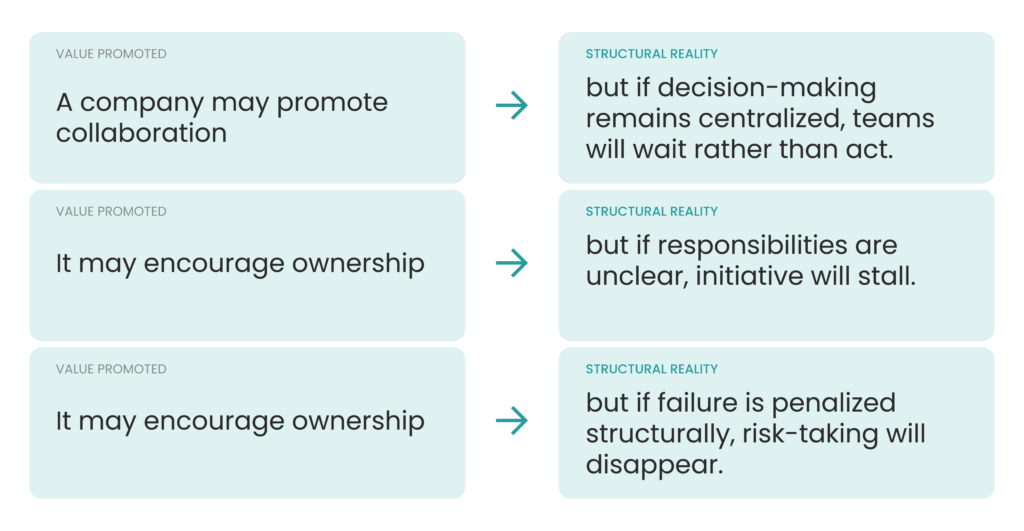
Over time, these patterns become predictable. Not because people resist change, but because the system makes certain behaviors easier than others. Values provide a clear indication of where an organization wants to go and structure determines whether it can get there.
This insight is well-established in organizational theory research.
In the early 1960s, Burns and Stalker studied how internal organization varied across British electronics firms operating in different competitive environments. Their central finding was that there is no single best way to organize — what matters is the alignment between structure and context.
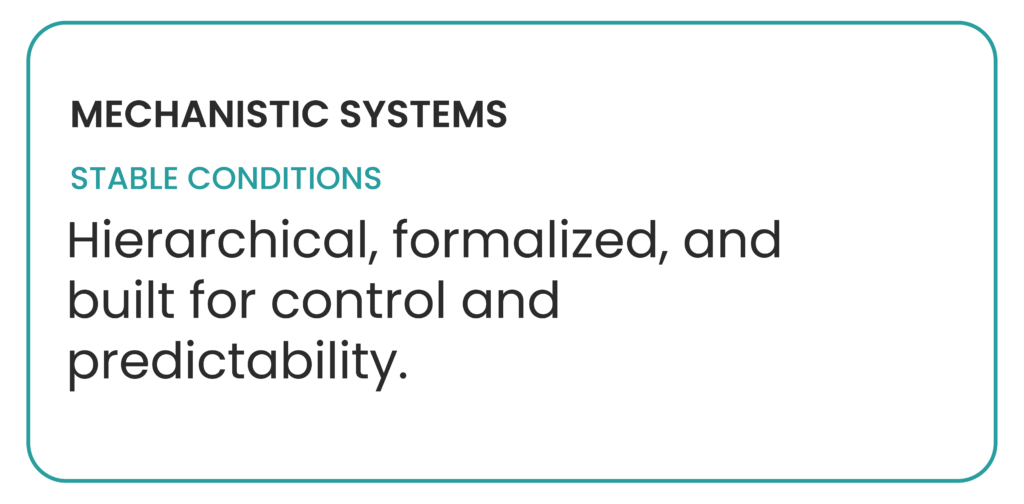
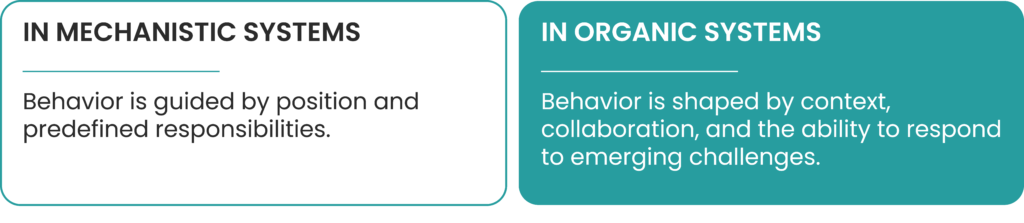
In stable conditions, organizations tend to rely on what Burns and Stalker described as mechanistic systems:
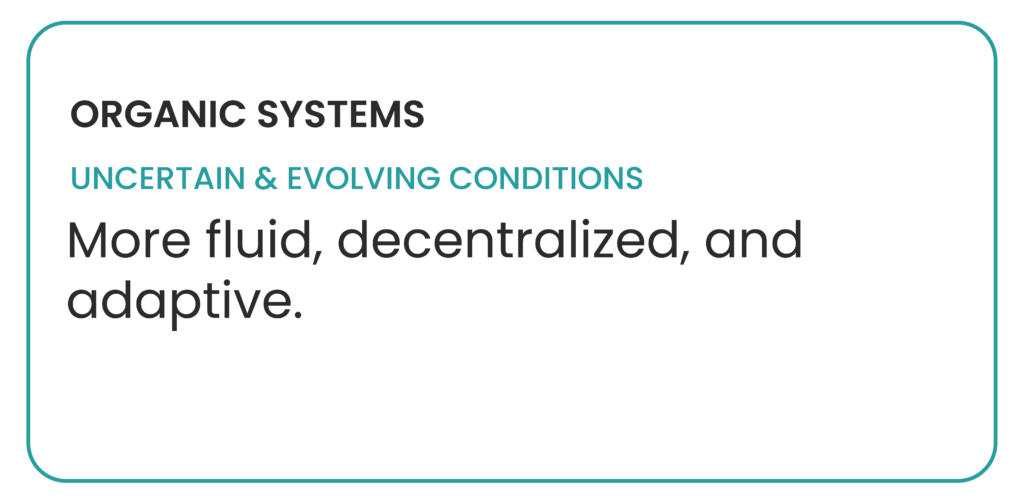
In more uncertain and evolving environments, organic systems emerge:
Critically, Burns and Stalker did not argue that one model is superior to the other. Their argument was one of contingency, the effectiveness of a structure depends on its fit with the environment it operates in.
The distinction is not about right or wrong. It is about fit.
This distinction matters. The definition of organizational environment has changed fundamentally. Markets are more volatile, problems less predictable, and work increasingly interconnected. Organizations are operating in conditions that demand more organic ways of working: adaptability, distributed decision-making, and continuous adjustment. But the structure often remains the same.
- Hierarchies persist.
- Roles stay rigid.
- Decisions continue to flow from the top.
The result is a growing misalignment between what the organization needs and how it is built. The soil has been enriched over time, but the roots are constrained by an outdated structure that prevents them from growing properly. Organizations try to grow collaboration, agility, and innovation, yet the underlying system continues to reinforce control, predictability, and specialization. The tree is expected to grow differently, but the conditions that shape its growth remain unchanged.
And when that happens, culture becomes performative. Values are expressed, but not embodied. Intent is clear, but behavior does not follow.
If culture defines what should grow, structure defines what actually can grow. Until structure evolves, culture will remain a promise rather than a reality.
3. What Do We Mean by “Structure”?
Too often, structure is reduced to an organizational chart, a static representation of reporting lines and hierarchies. In reality, structure is far more dynamic and far more influential.
Structure is the system that shapes how work is coordinated, how decisions are made, and how behaviors emerge across the organization. It defines how activities are directed, coordinated, and supervised to achieve collective goals.
As Henry Mintzberg articulated in his foundational work on organizational design, structure defines how activities are directed, coordinated, and supervised to achieve collective goals.
In other words, structure is not what the organization looks like, it is how the organization actually operates.
Going back to our metaphor, structure is not just the trunk of the tree. It is the entire growth system, the way roots expand, how nutrients circulate, and how the tree adapts to its environment over time.
To understand it, it helps to break down structure into four fundamental building blocks:
Governance
How Decisions Are Made
Roles & Responsibilities
Who Owns What
Governance defines who decides, how decisions are made, and where authority sits within the organization.
It establishes the rules of the game: decision rights, accountability, and the distribution of power. At its core, governance is the system of processes and structures that guide decision-making and ensure the organization can achieve its objectives.
In the metaphor, governance is what determines how nutrients flow through the tree, whether everything must pass through a central trunk, or whether branches can distribute resources more autonomously.
When governance is overly centralized, organizations tend to slow down.When it is too diffuse, alignment can suffer.
The challenge is not choosing one model over another, but designing decision-making mechanisms that fit the context.
If governance defines who decides, roles define who does what.
Structure provides clarity on responsibilities, authority, and how individuals contribute to the whole. It defines how tasks are distributed and how people relate to each other within the system.
Roles are the roots and branches themselves, each with a function, each contributing to the overall growth of the tree.
When roles are clear, ownership emerges naturally, however when they are blurred, accountability often diffuses.
In a more dynamic environments, roles cannot remain rigid, they need to evolve as the organization grows, just as branches and roots adapt to light, space, and external conditions.
Processes & Flow
How Work Actually Happens
Incentives & Metrics
What the System Reinforces
If roles define responsibilities, processes define how work moves.
They are the recurring patterns through which the organization operates: how information flows, how teams interact, how decisions are executed, and how coordination happens day to day.
Structure determines how information flows between levels and teams, and how tasks are coordinated across the organization.
Processes are ultimately the internal circulation system, the way water, nutrients, and signals move through the tree.
Even with the right governance and clear roles, ineffective processes can slow down or distort execution.This is often where the gap between intention and reality becomes most visible.
Finally, structure is not only about how work is organized, it is also about what is reinforced.
Incentives, performance metrics, and evaluation systems shape behavior in a powerful, often implicit way. They signal what truly matters within the organization.
In the metaphor, incentives are the environmental conditions that reinforce certain growth patterns, where energy is directed, which branches expand, and which ones do not.
An organization may promote collaboration, but if incentives remain individual, silos will persist. It may encourage long-term thinking, but if metrics are short-term, behaviors will follow accordingly. Over time, incentives become one of the strongest drivers of alignment, or misalignment.
Bringing it Together
Consider a practical illustration of how these four elements – governance, roles, processes, and incentives – interact. A global professional services firm repositioned itself around cross-functional client solutions. Leadership aligned on the vision, communication was clear, and values were updated accordingly. Yet, partners continued to optimize for individual revenue rather than collaborative client outcomes, because compensation structures remained tied to individual book-of-business metrics. The cultural intent was real. The structural signal was contradictory. Behavior followed the structure, not the values.
These four elements do not operate independently. They form a system, and it’s this system that ultimately shapes behavior. This is why structure is so powerful: it operates continuously, often invisibly, reinforcing certain ways of working while discouraging others. Which brings us back to the core idea:
Values define the direction of growth. Structure determines how that growth actually unfolds.
Unless these four building blocks are aligned with the environment and with each other, the organization will struggle to translate intent into reality.
4. The Alignment Problem: Culture vs Structure
Structure defines how the tree grows, and over time, its influence becomes clear, especially when growth takes a different direction than intended. At first, the signals are subtle:

Individually, these symptoms may appear operational. Collectively, they point to something deeper: a growing gap between what the organization is trying to become and how it is actually designed to operate.
This gap is often described as structural misalignment.
It occurs when the way an organization is built (its governance, roles, processes, and incentives) no longer supports its strategy, its environment, or its ambitions. Over time, this misalignment can lead to inefficiencies, unclear responsibilities, and slower decision-making, ultimately affecting performance and adaptability.
In our metaphor, the tree is expected to grow differently, but its roots still channel nutrients along the old path, limiting how that new growth can actually take shape.
What makes this challenge particularly complex is that misalignment rarely appears all at once, it emerges gradually.
Organizations evolve. Strategies shift. Markets become more volatile. But structures tend to lag behind, shaped by past success, legacy decisions, and institutional inertia. As a result, organizations often find themselves in a transitional state, one with a strategy that calls for speed, supported by decision processes designed for control and with a culture that encourages empowerment, constrained by unclear or overlapping roles a need for collaboration, limited by siloed incentives.
Each element, taken in isolation, may still function. But together, they create friction.
This is where a well-documented organizational phenomenon becomes relevant: what scholars describe as decoupling. First systematically examined by Meyer and Rowan (1977) and subsequently developed within institutional theory by DiMaggio and Powell, decoupling refers to the separation between formal intentions and everyday practices. Organizations may adopt new values, strategies, or structures to signal change, while operational reality continues to follow existing patterns.
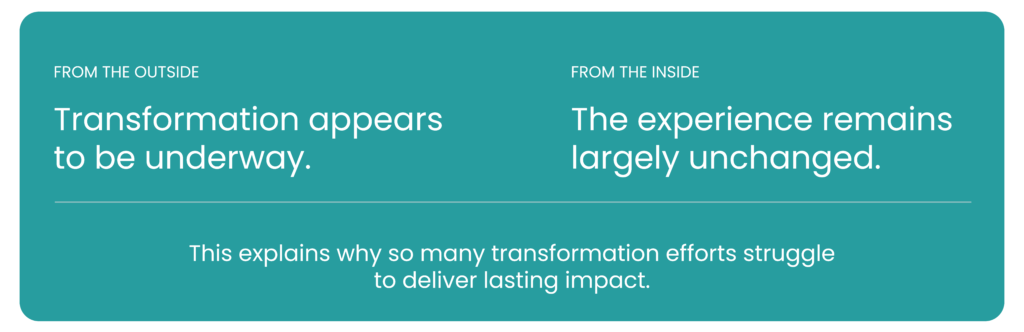
In most cases, the challenge is not the vision or even the strength of the culture. It lies in the system itself. Structures are built to provide stability and consistency, but transformation requires them to evolve and support adaptation.
Unless the underlying building blocks evolve together (governance, roles, processes, and incentives) misalignment persists, often invisibly, shaping behaviors in ways that contradict intent.
If culture defines the direction of growth, and structure defines how that growth unfolds, then misalignment is what happens when the two drift apart. And when they do, the organization does not stop growing. It simply grows in a way that was never intended.
5. From Statics Org Charts to Dynamic Operating Models
To understand why this misalignment persists, it is useful to step back and look at how organizations have traditionally been designed.
Most structures in place today were not built for the environment organizations now operate in. They were designed for a different context, one defined by relative stability, predictability, and efficiency.
This is precisely what Burns and Stalker observed in their seminal work on organizational design. They showed that structures are not inherently good or bad, but that their effectiveness depends on the environment in which they operate. In stable conditions, organizations tend to rely on what they described as mechanistic systems: hierarchical, clearly defined, and optimized for control and consistency.
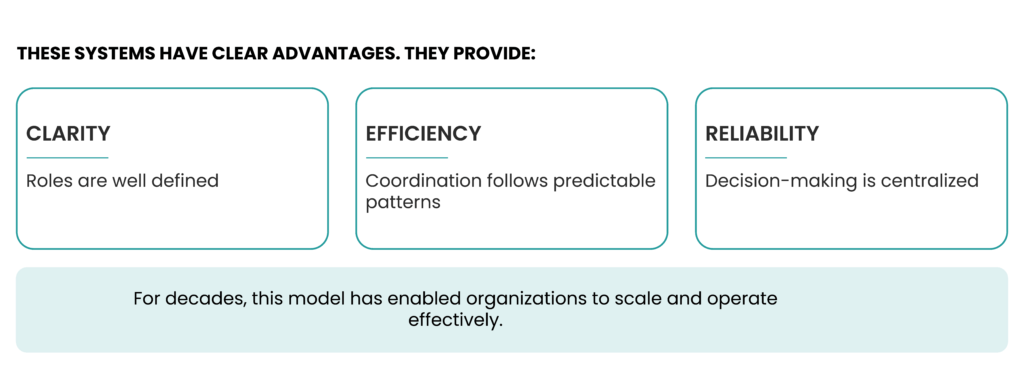
However, as environments become more complex and less predictable, the limits of this model begin to appear.
Burns and Stalker contrasted mechanistic systems with what they called organic systems: structures designed for change rather than stability. In these organizations, roles are more fluid, authority is distributed, and coordination relies less on hierarchy and more on expertise and interaction.
The difference is not simply structural, it is behavioral.
What makes this distinction particularly relevant today is the environment most organizations now face.
Markets evolve faster. Problems are less predictable. Work is increasingly interconnected. Under these conditions, structures designed for stability can struggle to support the level of adaptability required. Research consistently shows that mechanistic systems are more suited to stable environments, while organic forms perform better in dynamic and uncertain contexts.
And yet, many organizations find themselves operating in this tension. They are facing environments that demand adaptability, speed, and collaboration, while still relying on structures built for control, specialization, and predictability.
Structure, by nature, evolves more slowly than strategy or culture. It is shaped by past success, embedded processes, and accumulated complexity. As a result, organizations often attempt to operate in a new way without fundamentally changing the system that governs how work happens.
This brings us back to the core idea developed throughout this article.

When organizations operate in dynamic environments with structures designed for stability, the result is not resistance, it is friction. And over time, that friction becomes the limiting factor in transformation.
6. Practical Perspective: What Works (and What Doesn’t)
The relationship between structure and performance is most visible when the two diverge, and the most instructive lessons come not from familiar cautionary tales, but from cases that reveal the precise mechanisms by which structural change enables or obstructs transformation.
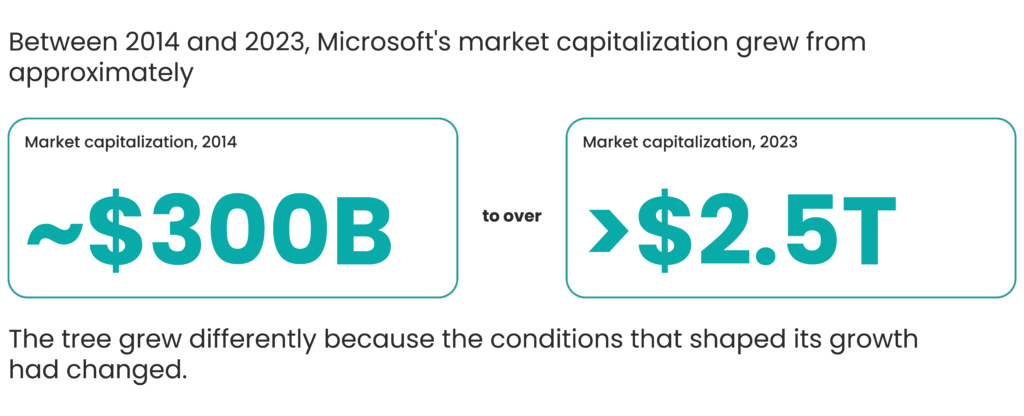
Few cases illustrate this more clearly than Microsoft’s transformation under Satya Nadella, who became CEO in 2014. When Nadella took over, Microsoft was widely described as a company in strategic drift, organized around competing product divisions, governed by a stack-ranking system that pitted employees against one another, and culturally resistant to the kind of cross-platform collaboration its cloud ambitions demanded. The cultural diagnosis was clear. But Nadella’s response was structural.
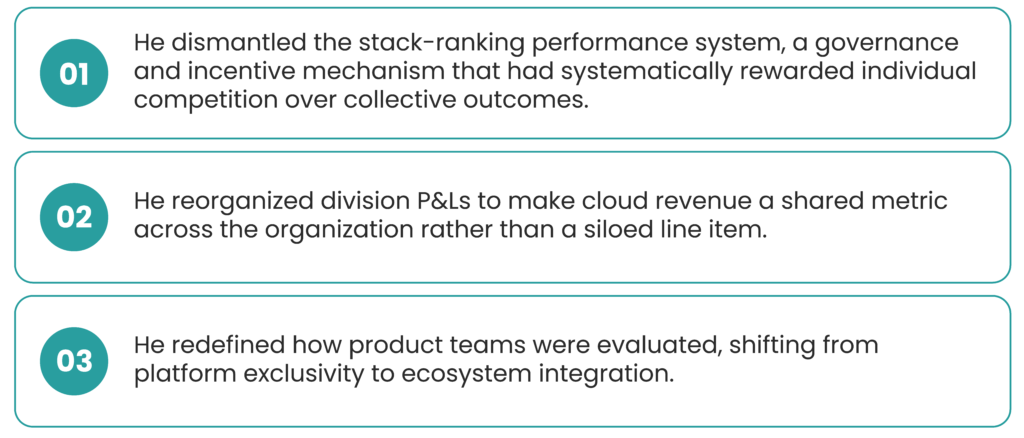
These were not cultural initiatives. They were structural interventions (changes to governance, incentives, roles, and processes) that made collaboration the path of least resistance rather than the exception. The cultural shift Nadella described as “growth mindset” was real and important. But it was the structural redesign that made it durable.
ING Bank’s agile transformation, launched in 2015, offers a complementary, and more cautionary, perspective. ING reorganised its entire retail banking headquarters in the Netherlands around squads, tribes, and chapters, directly inspired by the Spotify model but applied to a regulated financial institution.
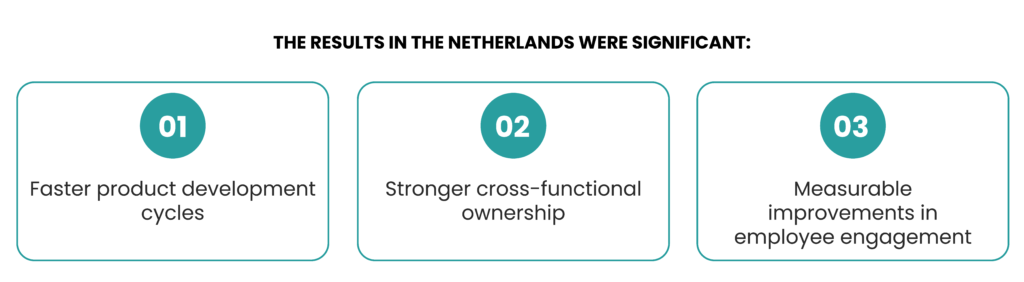
What makes the ING case particularly instructive, however, is what happened when other markets attempted to replicate it. Several country organizations copied the organizational structure (the squads, the tribes, the language) without changing the underlying governance or incentive systems. Decision rights remained centralized. Performance management continued to reward functional silos. The new structure existed on paper; the old structure continued to govern behavior in practice. The outcome was the worst of both worlds: the complexity of a new design without the benefits of genuinely distributed ownership. ING’s experience makes the mechanism of structural misalignment unusually transparent: it is not the org chart that drives behavior, it is the governance, incentives, and accountability systems underneath it. Change the chart without changing those, and the chart is irrelevant.
Netflix remains a frequently cited reference point, and it remains useful with important qualifications. The organizational principles described in No Rules Rules, by Reed Hastings and Erin Meyer, “people over process,” “context, not control,” “freedom with responsibility” were operationalized through concrete structural choices: no formal approval processes for many decisions, performance expectations tied to outcomes rather than process compliance, and radical transparency of strategic information. These are structural mechanisms, not cultural aspirations.
However, Netflix’s model depends heavily on what Reed Hastings himself described as “talent density”, a concentration of exceptionally high performers who can operate effectively with limited process guardrails. Hastings has acknowledged that the approach is difficult to replicate in organizations where that density is lower or where the operating environment demands more predictability. Its value lies not in replication, but in the underlying logic: structural choices, not cultural declarations, are what make certain behaviors sustainable.
The contrasting case of Blockbuster illustrates what happens when structure fails to evolve. Its governance remained optimized for a physical retail model, centralized decision-making, incentives tied to late fee revenue, and strategic planning processes ill-suited to rapid market shifts. When digital distribution emerged, these structural features constrained the organization’s ability to respond. External factors, including financial pressures from its Viacom ownership, compounded the difficulty. But the structural lag was real, and it was decisive.
Taken together, these cases point to a consistent pattern.
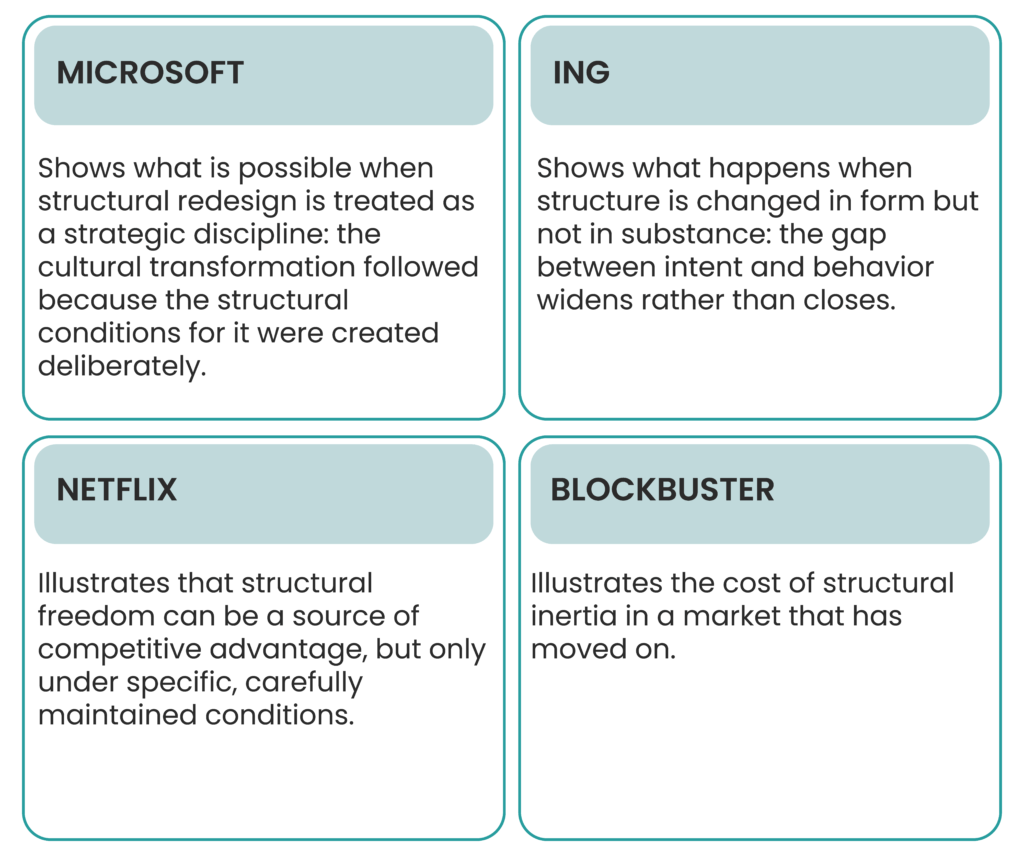
The lesson is not that any one model is superior. It is that the organizations which succeed treat structural design not as an organizational housekeeping exercise, but as one of the most consequential strategic decisions they make.
7. Toward Living Systems: Rethinking How Organizations Grow
If traditional structures were designed for stability, and organic models introduced adaptability, the next step goes further: it requires rethinking organizations not just as structures, but as systems.
Increasingly, organizations are being understood through the lens of complexity science and living systems theory, as dynamic, interconnected networks where performance does not come from the optimization of individual parts, but from the quality of their interactions. This perspective draws on a substantial body of research: Ralph Stacey’s work on complexity in organizations, Stuart Kauffman’s investigations into self-organization in complex adaptive systems, and Karl Weick’s foundational contributions to organizational sensemaking.
In this perspective, structure is no longer just about hierarchy or reporting lines, it becomes a set of relationships, flows, and feedback loops that continuously shape how the organization evolves. This shift is not theoretical, it reflects the reality of the environments organizations now operate in: uncertainty is no longer episodic, complexity is not reducible, change is continuous.
A useful point of departure is the work of biologist Stefano Mancuso on plant intelligence. Mancuso’s research demonstrates that plants, lacking a brain or central nervous system, nonetheless exhibit intelligent, adaptive behavior through distributed signaling across their root and vascular networks. Each part of the plant senses its local environment and responds, and from these local responses, coordinated behavior emerges at the level of the whole organism. His work is empirical biology: he studies plants, not organizations, and draws no conclusions about management or design.
The parallel to organizational systems, however, is worth drawing explicitly. What Mancuso describes in biological terms, maps onto challenges that modern organizations face in structural terms. The question it provokes is not “how do we make our organization more like a plant?” but rather: if coordination can emerge without hierarchy in biological systems, what does that suggest about the conditions under which it can emerge in human ones? That is an organizational question, not a biological one, and it is one the following frameworks help address.
The parallel to organizational design is suggestive, not prescriptive. Complex adaptive systems, whether biological or organizational, exhibit a capacity for self-organization: the emergence of order from local interactions between interconnected elements, without the need for central direction. Applied to organizations, this invites a different set of design questions: