The way organizations attract, develop, and retain talent is being rewritten in real time.
With AI accelerating, workforce expectations shifting, and volatility becoming the norm, the conversation has moved beyond fixing HR processes. The challenge now is to redesign HR into a strategic engine, capable of shaping how organizations adapt, scale, and evolve in a world that moves faster every quarter.
The HR Transformation Series is our monthly lens on that shift. Through the layers of culture, structure, and technology, we’ll explore how leading organizations turn disruption into a foundation for sustainable growth.

Why Traditional HR Models are no Longer Fit for Purpose
Over the past two years, the global workforce has undergone a structural stress test. The outcome is increasingly clear: organizations are not losing people because of technology disruption; they are losing people because they were not designed to adapt to it.
Multiple signals converge into this conclusion:
- In 2023, major consulting and technology firms laid off tens of thousands of employees, not primarily due to economic collapse, but because existing skill portfolios no longer matched strategic needs.[1]
- The World Economic Forum (2023) estimates that 44% of employees’ core skills will be disrupted within five years, driven by AI, automation, and new ways of working.
- Around 70% of digital transformation initiatives fail, with cultural resistance and unclear operating models cited as primary causes[2].
- Despite significant investment in HR technology, fewer than 10% of organizations can reliably link people data to business performance.[3]
The traditional HR model was built for a stable environment: predictable roles, long skill cycles, linear careers, and reactive interventions. That model cannot absorb the current pace of change. Four structural tensions explain why.
Why the Traditional Model Breaks
As a result, insights arrive too late to influence outcomes. You cannot lead proactively when problems are only visible after they materialize.
The conclusion is unavoidable: the old HR operating model cannot survive these tensions.
A New Model For Proactive HR Leadership

Figure 1 – HR Transformation Layers
To move from reactive administration to strategic foresight, HR leaders must adopt an operating model built on three tightly connected layers: Culture, Structure, and Technology & Data. This is the framework guiding the Ivy Partners HR Transformation article series.
Culture
The real operating system
Organizations often attempt to adapt by upgrading features: new platforms, redesigned processes, agile rituals, or AI tools. Yet they leave the underlying code untouched.
The Source Code Problem
Imagine using video-editing software to produce electronic music. Initially, basic sound features suffice. But as ambition and complexity grow, workarounds multiply and performance plateaus. The issue is not the features, it is the source code.
Organizations face the same constraint. Culture (the collective behaviours, decision patterns, risk tolerance, learning mindset, and response to change) determines whether transformation scales or stalls.
Research consistently confirms that cultural alignment is the strongest predictor of transformation success. It outweighs budget, technology, and formal organizational structure, which are rarely the true root causes of failure when transformations stall or collapse.
Culture is not a “soft” layer. It is the execution engine.
In proactive organizations, cultural code manifests in observable behaviours:
- Leaders reward learning velocity, not risk avoidance
- Managers deploy talent based on capability, not hierarchy
- Internal mobility is treated as the default, not the exception
Rewriting this code is a collective effort, but HR must act as the conductor, embedding desired behaviours across the entire human value chain: recruitment, onboarding, performance management, learning, promotion, and succession.
Without cultural rewiring, no structural or technological investment will deliver sustained impact.
Structure
The architecture of adaptability
If culture defines intent, structure determines whether intent translates into action.
Most organizational structures were designed for a slower, more predictable world. Fixed roles, rigid job families, and linear career paths inhibit responsiveness. A proactive HR structure must instead be dynamic, skills-driven, and fluid.
Leading organizations are shifting toward:
- Continuous skill mapping rather than static role descriptions
- Dynamic job architectures built around skill clusters
- Internal talent marketplaces that enable rapid redeployment
- Performance systems linked to capability growth, not tenure
Research shows that organizations adopting skills-based models are significantly more resilient and better positioned to redeploy talent during disruption.
Yet most organizations remain anchored to rigid job descriptions. How much critical work goes undone simply because it doesn’t “belong” to a formally defined role? How much inefficiency is self-inflicted by hard-coding narrow skill sets into static positions, rather than mobilizing capabilities dynamically across the organization?
This structural layer acts as the infrastructure that turns cultural intent into execution. Without it, adaptability remains aspirational rather than operational.
Technology and Data
From information to foresight
Proactive leadership is impossible without reliable, integrated intelligence. Yet despite decades of investment in HCM platforms, most organizations still operate with fragmented systems and inconsistent data.
The consequences are measurable:
Fewer than 10% of organizations effectively link people data to measurable business outcomes. As a result, workforce decisions are still largely driven by intuition, static reporting, or lagging indicators rather than evidence-based insight.
Organizations with mature people analytics capabilities achieve up to 25% higher productivity and 30% lower attrition. When workforce data is systematically linked to business outcomes, organizations make better talent decisions, intervene earlier, and reduce avoidable loss of critical skills.
Global Retail Transformation
Consider a global retailer with tens of thousands of frontline employees facing high turnover, uneven store performance, and rising recruitment costs. By integrating HR data with operational, scheduling, and sales systems, and establishing clear governance, the organization enabled leaders to:
- Identify burnout risk before attrition occurred
- Align staffing models with customer experience metrics
- Target training investments based on real-time skill gaps
- Equip managers with weekly people insights tied directly to performance
Within 12 months, voluntary turnover fell by over 18%, productivity increased, and recruitment costs declined materially.
The lesson is clear: value does not come from having data, but from operationalizing it.
Organizations that successfully make this transition are significantly more competitive. Another report by McKinsey found that companies leveraging people analytics are 3.1× more likely to outperform peers in revenue growth and 5× more likely to integrate HR, finance, operations, and customer data into a unified decision framework.[11]
Technology enables visibility; discipline turns visibility into foresight.
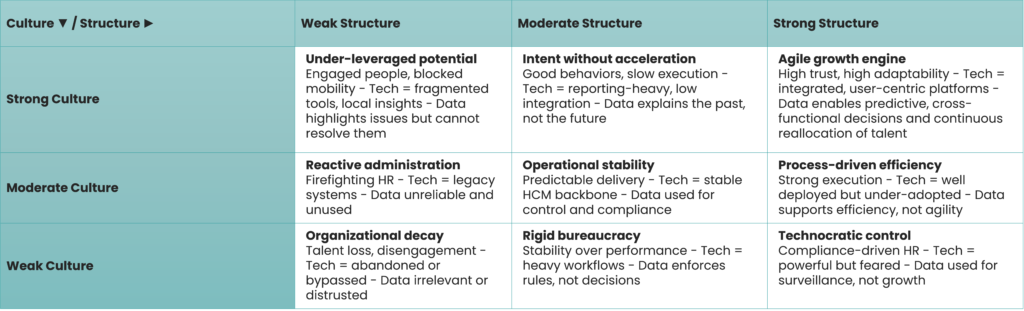
Table 1 - Culture–Structure Matrix with Technology & Data Dynamics
Taken together, culture, structure, and technology & data interact as a single system rather than as independent levers. The matrix above (Table 1) illustrates how different combinations of cultural strength and structural maturity shape the role technology & data can realistically play in HR.
From HR Administration to Organizational Leadership
The future of HR is not defined by tools, platforms, or frameworks alone. It is defined by the ability to orchestrate culture, structure, and intelligence as a single system.
As the matrix shows, technology & data only become a true accelerator when strong culture and robust structures are in place; without them, even sophisticated tools reinforce existing limits instead of expanding HR’s impact.
At Ivy Partners, we support organizations in rebuilding these three layers, so HR becomes a driver of organizational evolution rather than an administrative function. We work alongside HR teams to help them operate with clarity, leverage data with purpose, and adopt digital solutions that truly serve people and performance.
Our work focuses on:
When these layers align, HR moves beyond transformation initiatives and becomes a growth engine, capable of evolving continuously, scaling intelligently, and creating lasting value for both the organization and its people.
In the next article of this HR Transformation series, we will go deeper into the foundation of the model: Culture. We will explore why cultural “code” (not process, policy, or tooling) is the true constraint on HR impact, and how leadership behaviors, decision norms, and trust either enable or quietly sabotage every transformation effort.
About the Author

Fabio Panella is Business Unit Manager at Ivy Partners, where he supports organizations in their HR Transformation journeys, helping them lead change, strengthen operating models, and unlock new opportunities in fast-evolving environments.
With a Master’s degree in International Business Development and an entrepreneurial background, Fabio has supported growth-focused ventures, contributing to international market development and product relaunch initiatives in dynamic contexts.
Focused on people and performance, Fabio has led high-performing teams and built impactful partnerships across the markets he managed. Multilingual and experienced as an international speaker, he thrives in cross-cultural environments where clear communication, collaboration, and alignment are critical to delivering results.
References
[1] World Economic Forum (WEF). The Future of Jobs Report 2023. Available at: https://www.weforum.org/reports/the-future-of-jobs-report-2023
[2] Deloitte. Global Human Capital Trends 2023: New Fundamentals for a Boundaryless World. Available at: https://www2.deloitte.com/global/en/pages/human-capital/articles/global-human-capital-trends.html
[3] McKinsey & Company. The Organization Health Index. Available at: https://www.mckinsey.com/capabilities/people-and-organizational-performance/our-insights/the-organization-health-index
[4] Joe McKendrick, Half Of All Skills Will Be Outdated Within Two Years, Study Suggests, Forbes (Oct. 14, 2023). Available at: https://www.forbes.com/sites/joemckendrick/2023/10/14/half-of-all-skills-will-be-outdated-within-two-years-study-suggests/
[5] McKinsey & Company. Why Digital Transformations Fail. Available at: https://www.mckinsey.com/capabilities/people-and-organizational-performance/our-insights/why-digital-transformations-fail
[6] Bersin, J. (2015). High-Impact Talent Management Research. Bersin by Deloitte / Forbes. Available at : https://joshbersin.com/2015/12/why-diversity-and-inclusion-will-be-a-top-priority-for-2016/
[7] McKinsey & Company. Why Transformations Fail. Available at: https://www.mckinsey.com/capabilities/people-and-organizational-performance/our-insights/why-transformations-fail
[8] Deloitte. The Skills-Based Organization. Available at: https://www.deloitte.com/global/en/our-thinking/insights/topics/talent/skills-based-organization.html
[9]Bersin, J. (2015). High-Impact Talent Management Research. Bersin by Deloitte / Forbes. Available at : https://joshbersin.com/2015/12/why-diversity-and-inclusion-will-be-a-top-priority-for-2016/
[10] McKinsey & Company, HR Analytics Research (2024); Gartner Workforce Study; Appliview, Predictive Analytics in HR (2024)
[11] McKinsey & Company, People Analytics Research (2024); Deloitte, HR Analytics Report (2024)