There is increasing consensus that HR must evolve from a reactive support function to a proactive engine that shapes the future of work. But transformation cannot be reduced to implementing new tools, redesigning processes, or rolling out policies. Those are necessary, but not sufficient.
Because every transformation ultimately runs on an invisible layer that is rarely addressed directly: culture.
In this second article, we’ll explore the foundation model of HR impact: culture as the underlying system that shapes an organization.
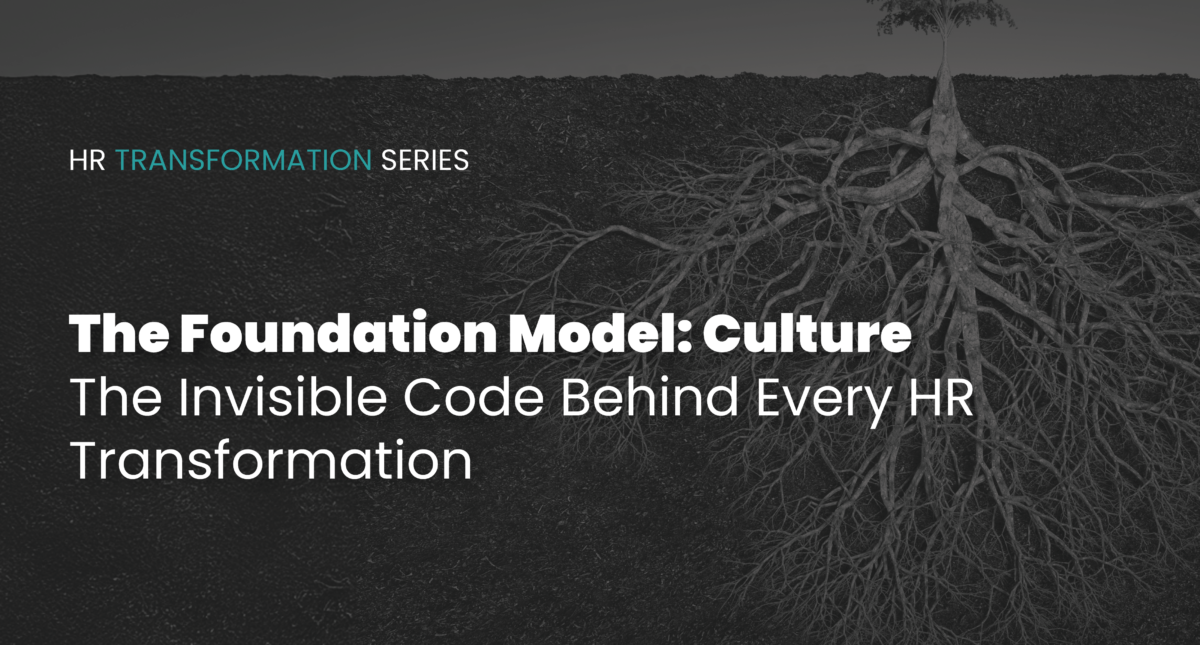
To use a simple metaphor, if we want to grow a tree, we need the right soil. Culture is not a simple set of values on a slide, even less so an employer branding narrative. Culture has to be seen and treated as the set of implicit rules and shared habits that determine:
This cultural “code”, more than processes, policies, or tools, is the true constrain on HR impact. It is shaped by leadership behaviours, decision norms, and trust. Determining whether transformation efforts succeed or fail.1

Culture: The Operating System of HR Impact
Most organizations try to transform HR through three levers:
-
New HR Technologies
-
New Processes
-
New Governance Models
Yet many of these transformations underperform, not because the tools are wrong, but because the environment in which they are deployed is misaligned.
The missing piece is culture.
Culture is not what is written. It is what is repeated. Values and frameworks are only meaningful when they are anchored in daily behaviour.2
In practice, culture lives in very concrete dynamics:
Culture is what makes certain behaviours safe, expected, possible, and others risky or invisible.
Culture is both the soil that enables growth and the operating system that shapes daily action. Just as software cannot run on an incompatible operating system, HR processes cannot deliver impact in a cultural environment that contradicts them.
You can implement the most advanced performance management system, but if feedback feels unsafe, it will not be used honestly. You can deploy sophisticated workforce analytics, but if decisions are political, data will not be trusted. You can design agile HR models, but if hierarchy dominates, collaboration will stall.
Culture (Not Talent): The Real Performance Multiplier
One of the most counterintuitive insights from organizational research is that team performance is not primarily driven by individual capability, but by how people interact.
Google’s multi-year research initiative, Project Aristotle, showed that what matters most is not who is on the team, but how the team works together.3 The strongest predictor of performance was psychological safety, the shared belief that individuals can speak up, take risks, and admit mistakes without fear of embarrassment or punishment.4
This insight changes how we think about performance. It is not only a function of talent. It is a function of culture-enabled behaviour.
If culture defines how people behave, and behaviour defines how systems are used, then culture becomes the primary constraint on HR impact.
This explains a recurring paradox: organizations invest millions in systems, frameworks, and methodologies, yet see limited change in outcomes. Because they try to change what people do without changing what people feel safe doing.
As long as speaking up feels risky, failure is punished, decision-making is opaque, and trust is low, every HR initiative will operate below its potential.
Culture is not a “soft” topic. It is the structural condition that determines whether transformation works or fails.
The Three Signals of High-Impact Culture
High-performing cultures are not defined by their slogans, but by a small number of repeatable behavioural signals. Across research and practice, three consistently differentiate high-impact cultures from dysfunctional ones: safety, vulnerability, and meaningful purpose5.
Safety
It is safe to speak, question, and act
Psychological safety is the foundation. It enables people to contribute, challenge, and learn without fear. In high-safety environments, feedback is honest, information flows faster, and innovation becomes possible.
The shared belief that individuals can speak up, take risks, ask questions, and admit mistakes without fear of embarrassment or punishment. It is not about comfort. It is about permission to engage fully.
As shown in Google’s Project Aristotle, psychological safety was the single most important predictor of team effectiveness, more than individual talent or team composition.
- Teams with high psychological safety are up to 2.5x more likely to be high-performing
- They deliver higher productivity and more innovation
- Sales teams with strong safety climates outperform targets by 17%
- 76% more engaged and 50% more productive
Without safety, people stay silent. And silence is one of the most expensive risks in any organization.
Vulnerability
It is safe to not know
If safety is the foundation, vulnerability is the catalyst. High-impact cultures are not built on invulnerability or perfection. They are built on mutual exposure to uncertainty.
In practice, this means:
- Leaders admit when they do not have all the answers
- Teams openly discuss mistakes
- People ask for help without fear of losing credibility
- Openness is met with support, not judgment
This creates a vulnerability loop: someone takes a small interpersonal risk, others respond with openness rather than judgment, trust increases, and collaboration deepens.
In low-vulnerability cultures, people protect themselves. In high-vulnerability cultures, people build together.
Purpose
It is clear why this matters
Purpose provides the directional logic that turns safety and vulnerability into action. It answers why the work matters, how it connects to something bigger, and what impact the organization is trying to create.
When purpose is clear and credible:
- People prioritize better
- Decisions become faster
- Alignment increases
- Energy concentrates on what matters most
In effective teams, individuals who believe their work has meaning and impact are significantly more engaged and committed to outcomes.
Clarity alone is not enough. Credibility comes from consistency. Without purpose, even the best-designed HR systems remain transactional.
The Interaction Effect
Individually, each of these signals is powerful. Together, they are transformative.
People feel safe, but without purpose or vulnerability there is no drive or depth. Safety without direction becomes stagnation.
People know the direction, but without safety they cannot truly commit. Purpose without trust becomes anxiety.
Without safety or purpose, openness becomes risk rather than connection. Vulnerability without structure becomes fragility.
High-Impact Cultures Align All Three
This Alignment Allows Organizations To:
Leadership Behaviours: The Code Writers of Culture
The answer is not HR policies. It is leadership behaviour.
Culture is written daily through micro-signals: how leaders react to bad news, how they make decisions under pressure, how they respond to dissent, and how they allocate attention and recognition. These signals accumulate into what employees interpret as “the real rules of the game”.
Three levers matter most.
Who is involved, how fast decisions are made, and whether dissent is welcome shapes how safe people feel to contribute.
Transparency, ownership, and delegation communicate whether people are expected to think or simply execute.
What leaders repeatedly talk about, celebrate, and tolerate defines what truly matters in the organisation.
This is why culture cannot be delegated to HR. It is encoded in leadership behavior, consciously or unconsciously, every day.
Why Most HR Transformations Fail: The Culture Mismatch
Most HR transformations fail for a simple reason: they try to change systems without changing behaviours.
Organizations invest heavily in new HRIS platforms, new performance frameworks, and new governance models. Yet outcomes remain limited because the cultural environment contradicts the intent of the tools.
- Performance management fails in low-trust cultures
- Data-driven HR fails where decisions are political
- Agile HR fails where hierarchy remains rigid
How HR can intentionally shape culture
If culture is behavioral, then it can be designed and reinforced through systems.
HR has four powerful levers:
of transformation
initiatives fail
because of Cultural resistance, not technology
Enables
The tools, systems, and platforms that make change possible. A necessary foundation, but not the deciding factor.
Organizes
Processes, hierarchies, and frameworks that give shape to transformation. It aligns people around a direction.
Determines
Whether change is actually adopted. Without cultural alignment, every other investment dissolves at the human layer.
Until culture shifts, transformation remains superficial.
In this sense, HR does not “own” culture, but it architects the systems that reinforce it at scale.
Culture in the Age of AI and Volatility
The importance of culture is increasing, not decreasing. We are entering a context defined by accelerating AI adoption, rapid skill disruption, and continuous organizational change.
will change within five years, while organizations simultaneously face pressure to adapt faster than ever.
In such an environment structures change, technologies evolve and roles are redefined. However, culture becomes the stability layer.
A culture of safety, trust, and shared purpose enables organizations to reskill faster, collaborate across functions and adapt continuously. Without it, every change creates friction, resistance, and fatigue. With it, change becomes a collective capability.
Culture: the Key to Unlocking the Future of Your Organisation
These dynamics are not theoretical. Across industries, we can observe how the alignment, or misalignment, of safety, vulnerability, and purpose directly shapes organizational performance over time. Two well-documented cases illustrate how culture can either amplify transformation or quietly undermine it.
Pixar
Creative Studio
Firestone
Manufacturing
These two cases illustrate a simple but powerful reality: culture does not only influence performance, it determines whether organizations can adapt, learn, and evolve over time.
Conclusion
Culture is the foundation model of HR transformation. The “soil” that defines how people behave, how decisions are made, and how change is experienced. It ultimately defines how your “tree” grows.
Without it, no HR initiative can reach its full impact. With it, even simple initiatives can unlock disproportionate value.
But culture alone is not enough. Once the behavioural foundation is in place, organizations must translate it into clear operating models, roles, and decision frameworks.
Have you ever wondered what signals your leadership behaviours send every day? Are they reinforcing or contradicting the culture you want to build?
In the next article of HR Transformation series, we will explore the second layer of the model, the Structure, and how to design organizations that convert cultural intent into execution capacity.
Reference List:
- Coyle, D. (2018). The culture code: The secrets of highly successful groups. Bantam Books. ↩︎
- FranklinCovey. (2025). The roadmap to successful culture change. https://www.franklincovey.com. ↩︎
- Google. (n.d.). Understand team effectiveness: Project Aristotle. Retrieved March 1, 2026, from https://rework.withgoogle.com. ↩︎
- Influence Journal. (n.d.). Why psychological safety drives performance. Retrieved March 1, 2026, from https://influencejournalforleaders.com. ↩︎
- FranklinCovey. (n.d.). Build a winning culture. Retrieved March 1, 2026, from https://www.franklincovey.com ↩︎
- LeaderFactor. (n.d.). Project Aristotle psychological safety and team performance. https://www.leaderfactor.com
- World Economic Forum. (2025). The Future of Jobs Report 2025. World Economic Forum.
About the Author

Fabio Panella is Business Unit Manager at Ivy Partners, where he supports organizations in their HR Transformation journeys, helping them lead change, strengthen operating models, and unlock new opportunities in fast-evolving environments.
With a Master’s degree in International Business Development and an entrepreneurial background, Fabio has supported growth-focused ventures, contributing to international market development and product relaunch initiatives in dynamic contexts.
Focused on people and performance, Fabio has led high-performing teams and built impactful partnerships across the markets he managed. Multilingual and experienced as an international speaker, he thrives in cross-cultural environments where clear communication, collaboration, and alignment are critical to delivering results.